




Types of pools

It is possible to classify pools from different perspectives. Pools can be classified into the following groups from a user perspective:
*Ocean Pools *Private Pools *Championship Pools *Public Pools *Training Pools *Therapeutic Pools
*Natural ponds or infinity pools
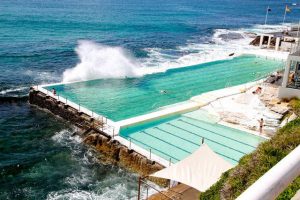
Ocean pools: These pools are built in coastal cities and along oceans and seas. In Australia, these pools are called lidos or beach resorts. The water needed for these pools is supplied by the tides throughout the day and night. Excess water also overflows the pool wall and flows into the sea. In addition to these pools, separate areas such as changing rooms, shower areas, sunbathing areas, etc. are usually included. Of course, in recently built ocean pools, a separate piping and pumping system is also installed to supply water to the pool.
Private pools: The dimensions of private pools are considered smaller than public pools. Private or home pools are usually built in dimensions of 4.8m x 9.6m to 6m x 12m, while the length of public pools is usually not less than 25m. Private pools can be built in two types: temporary and permanent. Temporary pools that are above ground can be collected in the winter and re-established in their place in the summer.
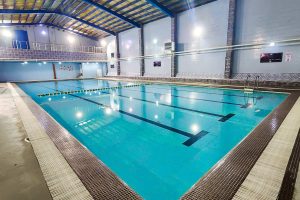
Public pools: Public pools are often a subset of sports centers in which there are various sections such as a hot water pool, indoor pool, outdoor pool, children’s pool, etc. Outdoor pools are usually used in tropical regions. Large and deep pools usually include a diving platform. Public pools are mostly built in a rectangular shape with a length of 12.5-25 or 50 meters.
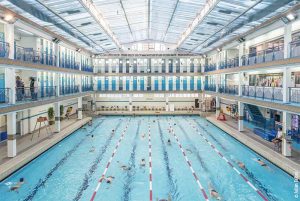
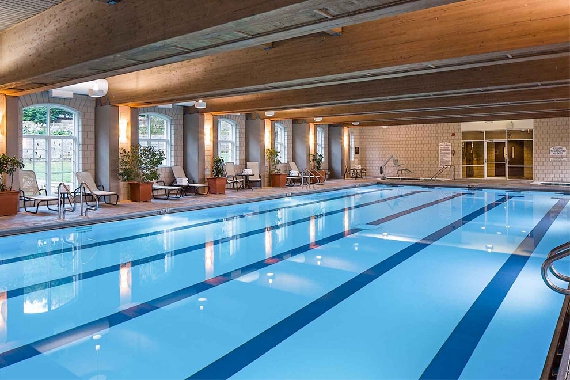
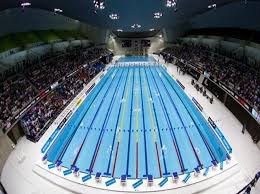
Championship pools: The specifications of championship pools used in international competitions are determined by the International Swimming Federation. Based on the standards of the Swimming Federation, championship pools must be 25 or 50 meters long and have a minimum depth of 1.35 meters. In order to be able to hold competitions all year round, championship pools are usually built indoors and the area inside the pool is equipped with appropriate heating systems.
Special Olympic pools are also a set of championship pools whose specifications must exactly match FINA standards. The length and width of these pools must be 25 and 50 meters, respectively. Their width is usually divided into eight separate lanes, each of which must be 2.5 meters wide.
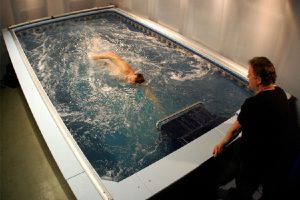
Training pools: These pools are usually built in small sizes between 5.0 x 2.5 meters or 16.4 x 8.2 meters. By creating an artificial water flow, the swimmer swims in place without moving. Training pools are also known by other names such as swimming machines and endless swimming pools. (Imax endless pools are a good choice for this type of pool)
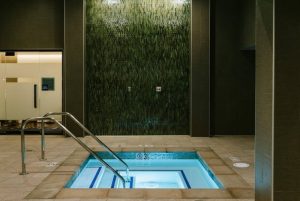
Therapeutic pools: The history of utilizing the therapeutic properties of water dates back to about 4,000 BC. Hydrotherapy involves the use of ice, steam, or hot or cold water with the aim of improving physical condition, eliminating physical discomfort, and improving body function. Therapeutic pools are divided into different groups, each designed and built for a specific purpose and with a unique structure.
Hot water pools (air and whirlpool pools)
Dry and steam saunas
Cold water pools
Natural hot water pools
In the not-so-distant past, hot water pools were used for relaxation, therapeutic applications, muscle tension relief, and the like. These types of pools were gradually phased out due to lack of comfort and problems such as water leaks.
Whirlpools, sometimes called whirlpool baths, are the same pools that are popularly known as jacuzzis. The word jacuzzi actually comes from the name of a company of the same name that was founded by seven Italian brothers in the United States. Whirlpools in their modern form were first mass-produced by the Jacuzzi company in 1968 and soon became known worldwide as jacuzzis.
Air pools, also known as air baths, are very similar to jacuzzis. The important difference between these pools and jacuzzis is that in air pools, instead of water, air is blown into the water through nozzles installed in the floor of the pool, which creates slight turbulence and a very gentle massage effect on the skin. Of course, these pools are older than jacuzzis. Air pools were used in hotels and aristocratic and luxurious houses. Jacuzzis can be easily recognized by the nozzles installed in the middle of the pool body. While the nozzles of air pools are completely placed on the floor. In air pools, cold water is sometimes used instead of hot water, while in jacuzzis only hot water is used.
Economically, air pools are more expensive to build than whirlpool pools, and under the same conditions, a larger pump must be used in them.
In air pools, air is blown into the pool bowl from the bottom of the pool, which is under the highest pressure. For air to enter the pool, the pressure due to the weight of all the water must be neutralized by a pump. As the air bubbles move upward, the pressure on them decreases, and in this way, the bubbles expand until they finally disappear at the water surface and enter the air. It is true that both air and whirlpool pools have therapeutic properties, but the reliance on therapeutic properties in air pools is much greater than in whirlpool pools. Air pools are only used in hydrotherapy centers and rehabilitation centers.
Cold water pools are another type of therapeutic pool. In addition to its relaxing properties, cold water has a very favorable effect on reducing swelling and inflammation of the skin. These pools are also sometimes used to relieve headaches or reduce the body temperature of sick people. Natural pools are another type of therapeutic pool in which hot water full of minerals usually boils from the ground.
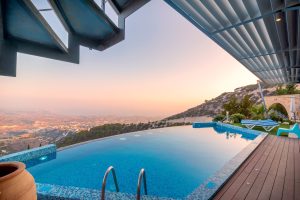
آNatural reservoirs: Sometimes called edgeless pools or infinity pools, they are a group of pools for which no clear boundaries can be determined. They usually form on the ocean floor and on mountain peaks. The edges of these pools act like a weir, which is approximately 25 mm below the water level. These pools are usually surrounded by a water collection channel in which the collected water is pumped back into the pool.
In artificial ponds, two different water circulation systems are usually used. One of these systems is similar to the conventional water circulation system of swimming pools, in which the pool water is pumped to the main part of the pool after passing through the filters and heater. In the water circulation system on the side of the water intake hub, the water is accumulated in the collection channel after passing through the filters and then sent to the upper pools by a pump. Types of pools in terms of structural material include: concrete pools, vinyl-lined pools, fiberglass pools, metal pools and wooden pools. Pools are also divided into the following two groups in terms of the location of the pool relative to the ground surface: in-ground and above-ground pools
In-ground pools are those pools that are built after excavating and digging a pit in the ground. While above-ground pools are usually placed on a foundation or platform above ground level. The structure of some of these pools is such that they can be easily moved from one place to another. The cost of these pools is much lower than permanent pools that are placed in the ground. This is because above-ground pools no longer require excavation, foundation construction, separate piping, and wiring, and all the required components and parts are supplied as a prefabricated set.
An example of an outdoor pool:
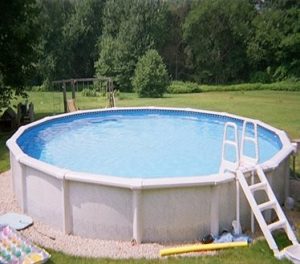
Example of an above ground pool: